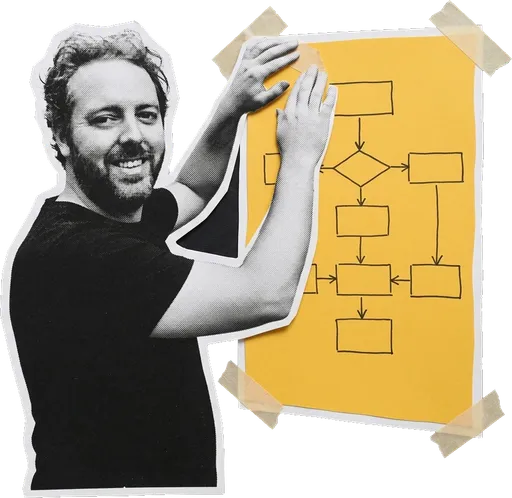
AI Discovery Sprint · for marketing and communication teams
From scattered AI experiments to a plan with owners.
From scattered AI experiments to a plan with owners.
In three to four weeks you know where AI adds the most, what IT allows and who picks up what.
In three to four weeks you know where AI adds the most in your team's process, what IT allows and who picks up what. And you have a working prototype to show. Fixed price.
Book an introductionBy Jelle Plass · Over a hundred facilitated workshops · Twenty years in digital
- 01Opportunities chosen by your team
- 02Tool check with IT
- 03A working prototype
- 04Roadmap with owners
In short
- Duration
- 3 to 4 weeks
- From your team
- One workshop day and a few hours
- You get
- Prototype and roadmap with owners
- Price
- Fixed, known in advance
Where it gets stuck
You need to do more with AI. Nobody says where.
Everyone on your team is trying something, each with their own tool. And you're caught in the middle: the question comes from above, the work sits with your team, and there's no time to figure out where to start.
- 01
Experiments fizzle out
As soon as the colleague who drove it moves on to something else, it stops.
- 02
The manual work stays
Checking, feedback rounds, retyping for every channel.
- 03
The question comes back
Someone above you wants to know what AI is delivering. Next time with a deadline.
The opportunity
Don't start with the tool. Start with the process.
If you know which work gets stuck every week, you also know where AI makes the difference. That's rarely the tool everyone is shouting about.
AI isn't the solution. It helps with the solution.
The opportunity
Don't start with the tool. Start with the process.
If you know exactly which work gets stuck every week, you also know where AI makes the difference. That's rarely the tool everyone is shouting about. It's the step your team waits on every week.
AI isn't the solution. It helps with the solution.
The AI Discovery Sprint
After the sprint you know where to start. And your team is behind it.
Your team picks the opportunities in its own process, and the decision-maker chooses in the room. It becomes their plan, not mine.
Your team picks the opportunities in its own process, the decision-maker chooses in the room, and afterwards there's something you can show. It becomes their plan, not mine.
Book an introduction- The process mapped
- How it really runs today, corrected by the people who do the work.
- Opportunities per step
- Where AI saves time or adds quality. And where it doesn't.
- Worked-out solutions
- The best opportunities as concepts, thought up by the team.
- Roadmap and 90-day plan
- What comes first, what comes later, and who picks up what.
- A working prototype
- Of the solution you put at the top.
- Tool check with IT
- What is allowed, what works and who looks after it. A clear yes or no, before anything gets built.
 The process mapped
 Opportunities per step
 Worked-out solutions
 Roadmap and 90-day plan
 A working prototype
 Tool check with IT
- The process mapped
- How it really runs today, corrected by the people who do the work.
- Opportunities per step
- Where AI saves time or adds quality. And where it doesn't.
- Worked-out solutions
- The best opportunities as concepts, thought up by the team.
- Roadmap and 90-day plan
- What comes first, what comes later, and who picks up what.
- A working prototype
- Of the solution you put at the top.
- Tool check with IT
- What is allowed, what works and who looks after it. A clear yes or no, before anything gets built.
How it runs
Four weeks, four steps.

WEEK 1
Week 1
Map
Intake and six to eight one-hour interviews. I draw out the process beforehand.
WEEK 2
Week 2
Choose
Workshop day on site. The team chooses opportunities, the decision-maker chooses the prototype.
WEEK 3
Week 3
Test
The tool check: two or three conversations with IT. Meanwhile I build the prototype in whatever gets through.
WEEK 3 OR 4
Week 3 or 4
Commit
Planning session on who picks up what. Then the report and presentation.
What it takes from your team
An hour per interview, one workshop day, a planning session of two to three hours and an hour-long presentation. The working out, the prototype and the report are on me.
From your team it takes an hour per interview, one workshop day, a planning session of two to three hours and an hour-long presentation.
Who I've done it for
Three teams, three times a chosen direction.
Delivered through agencies, for marketing and communication teams in Belgium and the Netherlands.
Railway company
Digital Content Team Belgium · 2026
The question
A content team of seven publishing in four languages while the volume keeps growing. An earlier AI attempt had stalled when the colleague working on it left.
What came out
Sixteen concepts, six of them on the roadmap. I rebuilt one of them live into a working form. The team chose to take it on internally.
Telecom provider
B2B Marketing Netherlands · 2025
The question
The team had to do more with AI but didn't know where to start. The wish: first decide where AI helps, and only then choose tools.
What came out
Three chosen challenges and four concepts, each worked out into a clickable prototype. With a roadmap for 2026.
Mobility group
Corporate Communications Netherlands · 2026
The question
An organisation already far along with AI, with its own academy for everyone. The communications team had the knowledge, but the building stayed with one person.
What came out
Five chosen issues and six concepts. The advice: first make the whole team skilled, then build together.
- 16 · 6 · 1concepts · roadmap · liveRailway companyContent team in four languages. I rebuilt one concept live into a working form.Digital Content Team Belgium · 2026
- 3 · 4challenges · clickable prototypesTelecom providerFirst decide where AI helps, only then choose tools. With a roadmap for 2026.B2B Marketing Netherlands · 2025
- 5 · 6issues · conceptsMobility groupThe team had the knowledge, the building stayed with one person. Advice: first make the whole team skilled.Corporate Communications Netherlands · 2026
1 of 3
After every workshop there was a direction. Who picks it up turned out to be the hardest part. That's why the follow-up is now part of the offer.
In all three, there was a chosen direction after the workshop. The step after that turned out to be the hardest: who picks it up. That's why the follow-up is now part of the offer itself.
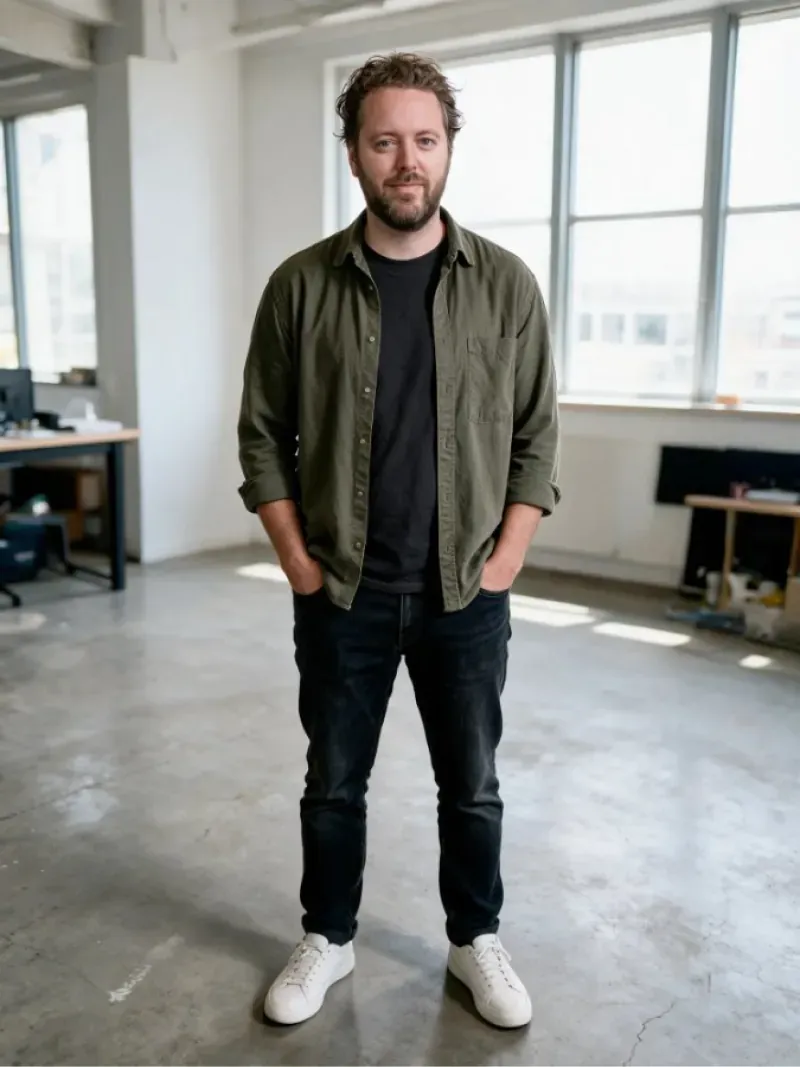
Who you get
Jelle Plass
Digital strategist and workshop facilitator, Antwerp
Who you get · Jelle Plass
Someone who gets a room to choose, and doesn't disappear afterwards.
I've run an agency myself, so I know what you go through as a client. My favourite moment is still the room that sees it can be done.
- 100+workshopsfacilitated workshops
- 20years in digital
- 8years facilitating
After the sprint
After week four you choose. Not building is an outcome too.
The roadmap says what comes first and who drives it. What you do next is up to you, with the result of the tool check alongside.
 A
Your team takes it on itself
With the roadmap, the prototype and an owner per initiative you have everything to carry on yourself.
 B
Build with your team
Six to eight weeks, one day a week, until the first workflows run. You choose who builds.
Six to eight weeks, one day a week. The first workflows run, and your team can carry on by itself afterwards.
See Build with your team →- C
Not building yet
If the tool check says no, or the gain is too small, you'll hear it. Better now than after three months of building.
Investment
Fixed price. Everything included.
One price for the whole sprint. You hear the amount before you decide anything.
After that, if you like: Build with your team. Six to eight weeks, one day a week, also at a fixed price in a separate proposal.
Introductory price for the first three teams
Introductory price for the first three teams
What's included
- Intake, interviews and the workshop day
- Tool check with IT and a working prototype
- Planning session, report and presentation
What happens next
- 1Introduction, twenty minutes
- 2Free scoping with whoever co-decides
- 3Proposal with fixed price and start date
After that, if you like: Build with your team. Six to eight weeks, one day a week, in a separate proposal.
Book an introductionQuestions
What you'd still like to know.
What you'd still like to know.
Six to eight one-hour interviews, one workshop day, a planning session of two to three hours and a one-hour presentation. The working out, the prototype and the report are on me.
That's why I talk to IT in week three, before anything is fixed. Everything is tested against the technology you already have. What isn't possible drops off or moves to later, and you know that before you invest in it.
The workshop day is one day out of four weeks. Before it, I map the process through interviews; after it, we test with IT and I build a working prototype. You're left with a roadmap with owners, not a pile of post-its.
One fixed price for the whole sprint. Travel costs are charged separately, as their own line in the proposal. You hear the amount in the proposal meeting, before you decide anything. The first three teams get an introductory price. If you'd like a ballpark figure earlier, just ask during the introduction.
By then you have a plan with owners and a working prototype, and your team can carry on by itself. If you'd like me to stay involved, there's a follow-up of six to eight weeks, one day a week. Also at a fixed price, in a separate proposal.
The interviews and the conversations with IT can be remote. I do the workshop day on site, because a room that chooses together works better than a video call. Everything can be in Dutch or English.
Yes. What you tell me stays between us, and I'm happy to sign a non-disclosure agreement. I only record conversations with permission, and I only use AI tools that are approved in your organisation. I never name you in a case without your consent.
Deciding together
Send this page to whoever co-decides.
Twenty minutes. Over coffee or on a video call.
You tell me about your team and the process you have in mind. I'll tell you honestly whether the sprint fits. No pitch.
- Price known in advance
- Free scoping first
- Price known in advance
- Free scoping first
- Four short questions, then you pick a time

Step 1 of 4
What is it about?
So I can prepare, and you know straight away whether I'm the right person.
Tell me a bit about it (optional)
Price known in advance · Free scoping first
Four short questions, then you pick a time.